Black is one of the most powerful colors in the world. It does not shout. It does not beg for attention. Yet, it controls the mood of a room, the tone of a brand, and even the way we feel about ourselves.
From luxury fashion to night skies, from mourning rituals to modern technology, black sits at the center of human experience.
Unlike bright colors, black works in silence. It absorbs light, creates contrast, and gives other colors their stage. Without black, there is no depth. No mystery. No sense of seriousness.
That is why black feels timeless. It never goes out of style because it never belongs to one era.
In daily life, you see black everywhere. In clothes, in cars, in screens, in logos, in art. Yet, most people never stop to think what black actually means.
This color carries more emotional weight than almost any other shade. It can feel safe and powerful, or cold and distant, depending on how it is used.
This guide takes a deep look at black from every angle. Meaning, psychology, spirituality, culture, and practical uses. You will see why black is not empty at all. It is full of meaning.
Key takeaways
- Black represents power, elegance, mystery, and authority, as well as death, fear, and the unknown.
- It creates a sense of control, seriousness, and emotional protection.
- Spiritually, black symbolizes the void, potential, endings, and transformation.
- Culturally, it plays a major role in religion, fashion, mourning, and identity worldwide.
- Black dominates branding, design, cinema, art, and personal style due to its versatility.
What is the color black?
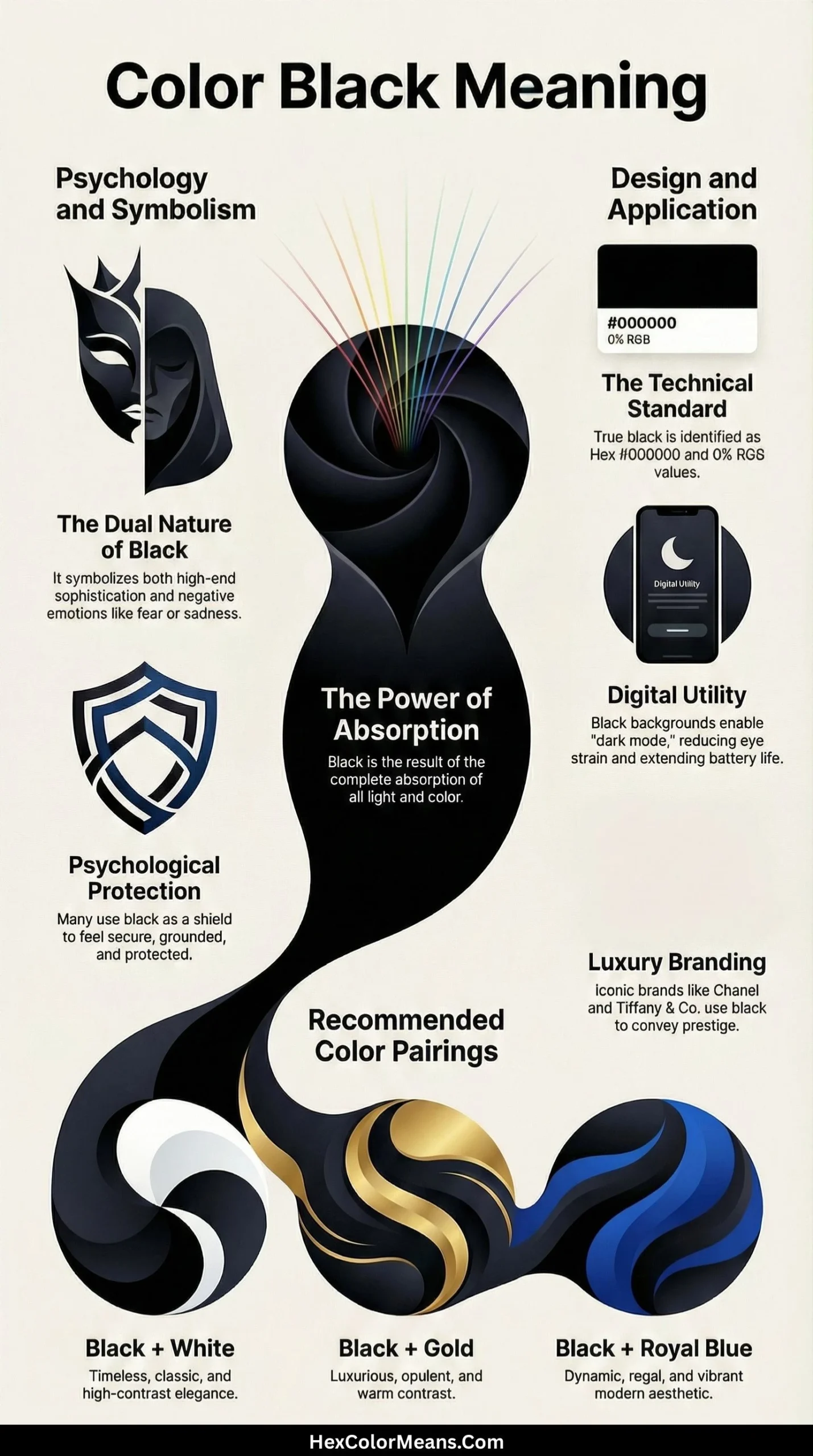
From a foundational standpoint, black is classified as an achromatic color. It is characterized by the complete absence or full absorption of visible light.
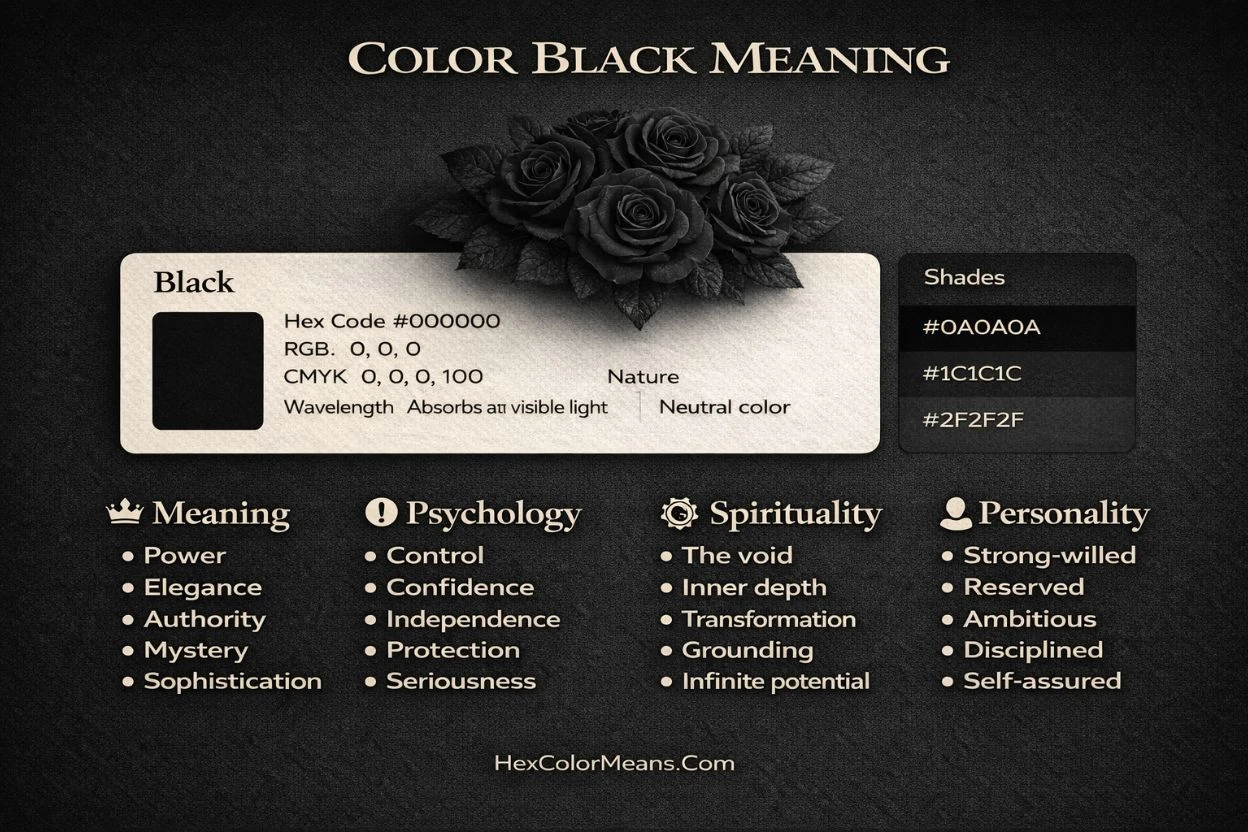
In modern digital systems, the color is defined by standardized codes that ensure consistency across devices and media. The most recognized technical values for pure black are:
- HEX Code: #000000
- RGB Values: (0, 0, 0)
- HSL Values: (0°, 0%, 0%)
- CMYK Values: (0%, 0%, 0%, 100%)
The physics of light provides another critical lens. Within the visible spectrum, a black surface does not emit or reflect a dominant wavelength. Instead, it absorbs almost all incident light photons.
This near-total absorption is why black objects feel warmer in sunlight than lighter ones. Importantly, human visual perception interprets this lack of reflected light as depth or void.
Scientific data confirms that black backgrounds can reduce eye strain and improve focus on highlighted content in certain environments. This inherent neutrality is a key reason for its widespread use in typography and foundational design.
Black is not a single shade. It carries different emotional tones based on its undertone and context. Its most popular shades include:
- Jet Black: A pure, deep black with a neutral tone linked with strength and modernity.
- Charcoal: A slightly softened black with gray undertones associated with professionalism and resilience.
- Obsidian: A rich black with a subtle, hard sheen connected to protection and clarity.
- Raven: A black with faint blue or purple undertones that feels luxurious and mysterious.
- Onyx: A dense, opaque black often tied to grounding and sophistication.
History and interesting facts
History of the color black
Black was one of the first colors humans ever used. Long before modern pigments, people made black from natural materials. Burnt wood created charcoal. Crushed bones made bone black. Soot from lamps produced lamp black.
These pigments were used in cave paintings, pottery, and early writing.
In ancient Egypt, black symbolized fertility and rebirth because of the rich black soil left by the Nile floods. That is why the god Anubis was shown in black. It represented both death and regeneration.
In medieval Europe, black pigments became more refined. Ink was black because it was easy to read and stable. Religious manuscripts used black for sacred texts.
Later, black clothing became a symbol of wealth because deep black dyes were expensive and hard to produce.
During the industrial era, black took on a new meaning. Coal, machines, factories, and formal suits all reinforced black as the color of seriousness and modern life.
Even today, black still feels professional, urban, and controlled.
Interesting facts about the color black
Black absorbs more heat than any other color, which is why black cars get hotter in the sun. Many luxury brands use black logos because black increases perceived value and authority.
In photography, black creates depth and focus by removing distractions from the frame. In space, black represents the unknown, which is why black holes fascinate scientists and artists alike.
Black clothing is often chosen when people want to feel slimmer or more confident. In psychology experiments, people wearing black are often seen as more dominant.
In digital design, black backgrounds reduce eye strain in low light environments.
Symbolism and representation
Black symbolizes opposite ideas at the same time. It represents power and fear, elegance and emptiness, protection and isolation. This dual nature is what makes black so emotionally strong.
On one side, black stands for authority. Judges wear black robes. Luxury cars are often black. High end fashion uses black to signal class and confidence.
When something is black, it feels serious and important.
On the other side, black represents darkness and the unknown. Night is black. Death is linked to black. That is why black can feel heavy or intimidating.
It reminds people of what they cannot see or control.
Black also symbolizes boundaries. It creates emotional distance. People who wear black often want privacy or protection. They are not inviting attention. They are setting a wall.
Yet at the same time, black offers comfort. It hides flaws. It reduces chaos. And, it creates a sense of order.
That is why minimal design often relies on black. It brings calm through simplicity.
Meaning of the black color in spirituality
Spiritually, black represents the void—the space before creation where everything begins and ends. Many traditions see black as the color of potential, a neutral force that holds infinite possibilities.
In Eastern philosophies, it is linked to deep wisdom and inner knowledge. It embodies silence, meditation, and the unseen forces of the universe. Black is not negative; it is powerful, protective, and transformative.
In spiritual symbolism, black often marks transitions—endings that lead to new beginnings. Death, in this context, is not final but a gateway to rebirth.
That is why black is frequently used in rituals aimed at change, protection, or personal transformation.
Black aura
A black aura can indicate protection and strength, acting as a shield against negative energy. People with a black aura are often highly intuitive, absorbing and neutralizing the emotional and spiritual turbulence around them.
It can also signify a period of introspection or inner healing, where someone withdraws from external distractions to focus on personal growth.
Black crystals
Black crystals, such as obsidian, onyx, and black tourmaline, are known for their grounding and protective qualities. They absorb negativity, repel harmful energies, and help stabilize emotions.
Many use black crystals in meditation or carry them as talismans to create a safe and calm environment, allowing inner clarity to emerge.
Black candle color
Black candles are commonly used in spiritual practices to symbolize endings, release, and protection. Lighting a black candle can help one let go of old habits, emotional baggage, or negative influences.
They are also used in spells or rituals to banish negativity and create a space of spiritual cleansing. The act of burning a black candle represents transformation—what is released makes way for new opportunities.
Rituals involving black
Rituals using black often focus on protection, transformation, and spiritual cleansing. Common practices include meditating with black crystals, lighting black candles during intention-setting, or surrounding oneself with black objects during moments of reflection.
These rituals create a safe, neutral space where energies are absorbed, processed, and transformed. Many people also use black in protective charms, wards, or personal spaces to maintain balance and repel unwanted energies.
In essence, black in spirituality is about embracing the unseen, honoring the cycles of endings and beginnings, and using its neutral power for protection, reflection, and growth. Far from dark or ominous, black is a color of profound potential and inner strength.
Psychological meaning of color black
Psychologically, black creates a sense of control. It reduces emotional exposure. It makes people feel guarded but safe.
When someone prefers black, they often value independence, strength, and privacy. They do not like being judged. They prefer depth over surface level interaction.
Black can also signal emotional withdrawal. In excess, it may reflect sadness, fear, or emotional walls. That is why therapists sometimes notice color choices in clothing or art.
In environments, black creates seriousness. A black room feels quiet and intense. A black interface feels focused and modern. However, too much black can feel heavy and isolating.
Used wisely, black gives balance. It grounds bright emotions. It adds structure to chaos. Also, it gives the mind a place to rest.
Color black personality traits
Positive traits
People who feel drawn to black often carry a strong inner world. They value depth over noise. They prefer quality over quantity. Most of the time, they think before they speak, and they rarely act on impulse.
Black personalities are usually independent. They do not like being controlled. They prefer to make their own rules and walk their own path. Even in social situations, they keep a part of themselves private.
They are also seen as confident and composed. Not loud. Not flashy. Their confidence feels calm and steady. Others often trust them in serious matters because they appear reliable and emotionally stable.
Another strong trait is self-protection. Black lovers know how to set boundaries. They do not easily reveal their fears or weaknesses. This makes them emotionally resilient, especially during stressful situations.
Negative traits
On the darker side, black personalities can become emotionally closed. They may struggle to express feelings, even when they need support. This can create distance in relationships.
They may also appear cold or intimidating. Not because they lack kindness, but because they avoid vulnerability. People sometimes misread their silence as arrogance or disinterest.
Another challenge is control issues. Black lovers often want to stay in charge of situations. When they lose control, they may feel anxious or frustrated.
In extreme cases, black can reflect fear of exposure. A desire to hide flaws. A fear of being judged. Over time, this can turn into isolation if not balanced with openness.
What does the Bible say about color black?
In the Bible, black often symbolizes suffering, mourning, and spiritual trials. It is linked with darkness, famine, grief, and human weakness.
In the Book of Lamentations, black represents deep sorrow: “My skin has grown black and fallen from me; my bones burn with fever.” (Lamentations 5:10)
In Job, black reflects intense pain and emotional distress: “I go about blackened, but not by the sun; I stand up in the assembly and cry for help.” (Job 30:28)
Black is also connected with judgment and despair: “The day of the Lord is darkness, not light.” (Amos 5:18)
However, black is not only negative. In biblical symbolism, darkness often comes before divine intervention. It represents the human condition without God. The absence of light creates space for spiritual awakening.
In this way, black becomes a reminder of humility. Of dependence. Of transformation through faith.
Cultural and religious significance of the black color
Black carries very different meanings across cultures. Yet, it always holds emotional power.
- In Western cultures, black is the primary color of mourning and funerals. It represents respect for the dead and emotional restraint. At the same time, black is also the color of formal elegance, worn at weddings, galas, and official events.
- In Christianity, black symbolizes sin, death, and repentance, but also humility and seriousness. Priests often wear black to represent detachment from worldly pleasures.
- In Islam, black holds sacred value. The Kaaba in Mecca is covered in black cloth, symbolizing divine authority and spiritual unity. Black also represents strength and dignity.
- In Hinduism, black is linked to protection and destruction of evil. The goddess Kali is depicted in black, showing power over fear, time, and death.
- In Buddhism, black symbolizes ignorance and suffering, but also deep meditation. It represents the mind before enlightenment.
- In African cultures, black often symbolizes maturity, masculinity, and spiritual energy. It connects with ancestors and hidden knowledge.
- In Japanese culture, black represents mystery, experience, and formality. Samurai armor was often black to show strength and discipline.
Dream interpretations of color black
Seeing black in dreams usually connects with the subconscious mind. It often reflects emotions that are hidden or unresolved.
Dreams filled with black may symbolize fear of the unknown. Uncertainty about the future. Emotional confusion. Or a situation where clarity is missing.
However, black does not always mean something negative. Sometimes it represents protection and emotional retreat. The mind pulling inward to heal.
A black door in a dream may symbolize a new phase. A black room may represent self-reflection. Similarly, a black figure may reflect suppressed emotions or unexplored parts of personality.
In spiritual dream analysis, black often appears before personal growth. It marks the end of one chapter and the silent start of another.
How to use the color black
1) Color black in business
In business, black stands for authority, professionalism, and credibility. It is widely used in corporate environments because it signals seriousness.
Black suits are common in leadership roles. They communicate power without needing explanation. Black office spaces feel structured and focused.
Many legal, financial, and consulting firms use black in their identity to create trust. Clients associate black with discipline and responsibility.
However, too much black can feel rigid. That is why successful brands mix black with lighter colors to avoid emotional distance.
2) Color black in branding and marketing
Black is a favorite in premium branding. It increases perceived value. It feels expensive, even when the product is simple.
Luxury brands like Chanel, Apple, and Nike rely heavily on black. It creates contrast. It highlights logos. And, it removes distractions.
In marketing psychology, black appeals to people who seek status, control, and minimalism. It attracts mature audiences more than playful ones.
Black also works well in digital products. Dark mode reduces visual fatigue and increases focus.
3) Color black in interior design
Black in interiors adds depth and drama. It makes rooms feel grounded and sophisticated.
Black walls create intimate spaces. Black furniture feels solid and reliable. Black accents give contrast to neutral palettes.
However, balance is essential. Too much black can shrink space visually and make rooms feel heavy.
Designers often pair black with white, beige, or gold to create harmony. This keeps the space elegant without feeling closed.
4) Black color in cinema
In cinema, black controls mood more than almost any other color. Directors use it to create tension, mystery, and emotional weight.
Black shadows hide information. They build suspense. That is why thrillers, horror films, and noir movies rely heavily on darkness. The absence of light forces the viewer to focus on emotions rather than details.
Costume design also uses black to define character roles. Villains often wear black to symbolize power, danger, or emotional detachment. Heroes may wear black when they go through darker phases of their journey.
Black and white films use contrast to tell deeper stories. Without color distractions, emotions feel stronger. Every expression becomes more meaningful.
5) Black color in humans
In human behavior, black reflects emotional boundaries. People choose black clothing when they want to feel safe, serious, or invisible.
Black is also associated with authority and maturity. Teachers, judges, and leaders often wear black because it creates psychological distance and respect.
Emotionally, people gravitate toward black during difficult phases. Grief, stress, heartbreak, or personal transformation often come with darker clothing choices.
At the same time, black is linked with confidence and self-control. Many people wear black when they want to feel powerful, slim, or composed. Black becomes a shield. It protects identity while still projecting strength.
6) Black color in makeup
In makeup, black is the foundation of definition. It shapes the eyes, sharpens facial features, and adds drama.
Black eyeliner makes eyes look larger and more intense. Black mascara adds depth and emotion to expressions. Smoky black eyeshadow creates mystery and boldness.
In fashion makeup, black lips and nails signal rebellion and individuality. They reject softness and highlight self-expression.
Black makeup works because it creates contrast. It highlights skin tones. It draws attention to structure rather than color. Used lightly, black feels elegant. Used heavily, it feels edgy and powerful.
7) Black food
Black foods often symbolize richness and intensity. They feel deep, earthy, and nourishing.
Examples include black beans, black rice, blackberries, olives, and dark chocolate. These foods are often linked with antioxidants and strength.
Culturally, black foods are associated with grounding energy. They are believed to strengthen the body and stabilize emotions.
Black coffee and dark chocolate also reflect emotional depth. They feel mature, bitter, and complex compared to sweet alternatives.
8) Black color in quotes and idioms
Black appears in many expressions because it connects with human emotion.
Phrases like “black sheep” reflect isolation or uniqueness. “Black and white” represents clarity and truth. “In the black” symbolizes financial success.
Black humor refers to dark or serious comedy. A black day means something tragic or difficult.
These expressions show how deeply black is rooted in emotional language. It always points toward intensity and seriousness.
9) Black color in art and architecture
In art, black creates structure. It outlines forms. It defines contrast. Without black, most compositions feel flat.
Artists use black to guide attention. It creates silence between colors. It adds emotional weight to paintings.
In architecture, black buildings feel bold and modern. They stand out without decoration. Black materials like marble, steel, and glass symbolize strength and permanence.
Minimalist design relies heavily on black. It removes noise and lets space breathe.
10) Songs with black in the title
Many songs use black to express emotional depth. Black usually symbolizes loss, mystery, or internal struggle.
Examples include “Back in Black”, “Paint It Black”, “Blackbird”, and “Black Magic Woman”.
In music, black represents emotional honesty. Songs with black in the title often explore pain, rebellion, or transformation.
11) Cities with color names: Black
Some places carry black in their identity. The Black Sea reflects mystery and ancient trade routes. Blackpool represents industrial history. Black Forest in Germany symbolizes nature and folklore.
These names often connect black with depth, history, and natural power.
12) The color black in the garden
In gardens, black creates dramatic contrast. Black flowers and foliage highlight brighter colors around them.
Plants like black tulips, black roses, and dark-leafed shrubs create visual focus. They add elegance and mystery to landscapes.
Black pots and pathways ground garden design. They frame natural beauty and add structure.
In symbolic gardening, black plants represent transformation and protection.
Final thoughts
Black is not empty. It is full of meaning.
The color black holds power without noise. It creates emotion without color. It reflects human fears and human strength at the same time.
Black teaches balance. Between light and dark. Between exposure and privacy. And, between control and surrender.
Whether in fashion, psychology, spirituality, or design, black remains timeless. It never fades. It never loses relevance.
Black is the silent language of depth. And that is why it will always matter.