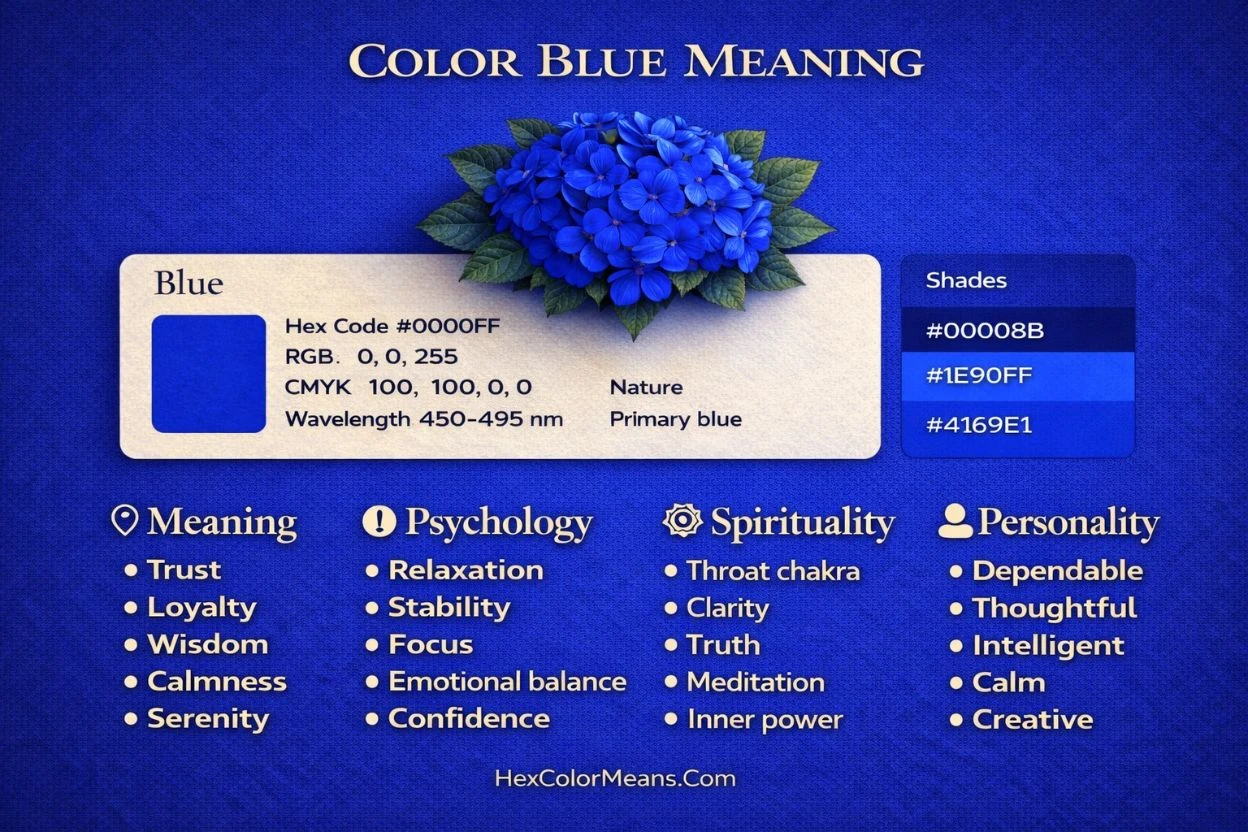
Blue is a color that resonates with calmness, depth, and stability. It evokes a sense of serenity, wisdom, and trust, making it one of the most universally appreciated colors in the world.
From the skies above to the oceans that stretch endlessly, blue surrounds us in ways both natural and symbolic. Beyond its aesthetic appeal, blue carries rich psychological and spiritual significance.
It influences our moods, behaviors, and even cultural practices, serving as a color that balances intellect and emotion. Whether in design, fashion, or spirituality, blue has a unique power to communicate feelings without words.
Key takeaways
- Blue promotes calm, trust, and productivity but can also evoke sadness or detachment if overused.
- Color blue is spiritually associated with intuition, inner peace, and higher consciousness across multiple spiritual traditions.
- Blue represents loyalty, authority, and tranquility in various cultures, often used in rituals, art, and attire.
- From branding and interior design to fashion and food, blue has practical uses that influence perception and emotion.
- Individuals drawn to blue often value honesty, loyalty, and calmness, though excessive reliance on blue may indicate introversion or indecision.
What is color blue?
Blue is a primary color positioned between green and violet on the visible spectrum. Its wavelength measures approximately 450–495 nanometers. Scientifically, blue light has a shorter wavelength than most colors in the spectrum, giving it a crisp, clear quality.
Consequently, this sharpness makes it closely associated with calmness, clarity, and mental focus.
In color science, pure blue is visible by stimulating the blue cone cells in our eyes. Unlike warmer colors, like red and orange, blue recedes visually, creating a sense of depth and tranquility.
This makes it a powerful tool for evoking stability, serenity, and trust in both nature and design.
To reproduce blue accurately in digital and print media, designers use specific color codes:
- Hex Code: #0000FF
- RGB Code: (0, 0, 255)
- CMYK Code: (100, 100, 0, 0)
However, blue is far from a single tone. From the soft, airy Sky Blue to the deep, regal Royal Blue, its popular shades each convey a distinct mood.
The spectrum continues with the rich Cobalt, vibrant Cerulean, and intense Ultramarine, proving its remarkable versatility in art, design, and daily life.
History and interesting facts
History of the color blue
Blue has a fascinating history shaped by rarity, trade, and innovation. Ancient civilizations often struggled to produce true blue pigments. The earliest known blue pigment, Egyptian blue, dates back to around 2600 BCE. It was made from ground minerals like copper and calcium, used in tombs, statues, and murals.
In ancient Mesopotamia and Egypt, blue was associated with divinity and royalty. The deep lapis lazuli pigment, imported from Afghanistan, was more precious than gold and used to create sacred artworks and jewelry.
During the Middle Ages, blue became a symbol of the Virgin Mary in Christian art, representing purity and faith. It wasn’t until the 18th century that synthetic pigments, such as Prussian blue and cobalt blue, made the color more accessible, revolutionizing art, fashion, and decoration.
Interesting facts about the color blue
- Rare in Nature: True blue pigments are uncommon in plants and animals, which is why blue often symbolizes rarity and preciousness.
- Blue Jeans Origin: The iconic denim blue comes from indigo dye, a natural plant-derived color used for centuries in textiles.
- Cultural Prestige: Lapis lazuli was highly prized in ancient Egypt and Europe, often used in royal and religious artifacts.
- Optical Illusion: Blue is perceived as a distant color in landscapes, creating depth in art and design.
- Psychology of Appetite: Unlike red or yellow, blue can suppress appetite, making it rarely used in food marketing.
- Symbol of Trust: In modern branding, blue dominates corporate logos because it conveys reliability and professionalism.
Symbolism and representation
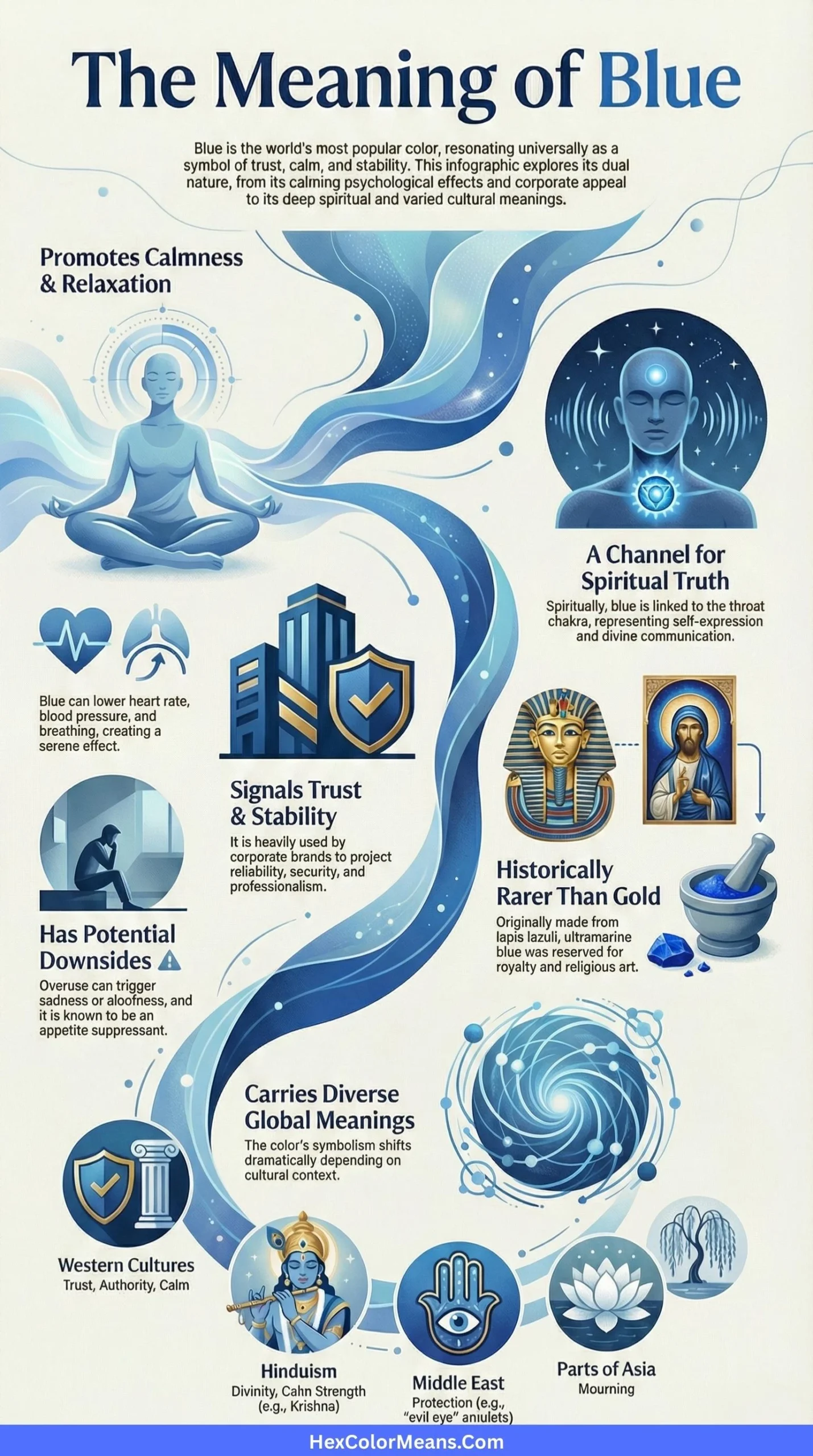
Blue carries layered meanings shaped by environment, history, and belief. In Western contexts, it stands for trust, loyalty, and professionalism—think corporate logos and police uniforms. Yet it also embodies melancholy, as in the phrase “feeling blue.”
In the Middle East, blue acts as a protective talisman—the “evil eye” amulet is almost always blue to ward off misfortune. In Hinduism, the god Krishna’s blue skin signifies divine love and cosmic power. Chinese culture links blue to healing, immortality, and the east, though it can also imply unpredictability.
Globally, blue bridges opposites: it is both calm and deep, distant and intimate, earthly and celestial. Its universality lies in its ability to reflect the human need for both security and transcendence.
Meaning of the blue color in spirituality
In spiritual practice, blue is the color of the throat chakra (Vishuddha), the energy center governing communication, truth, and self-expression. A balanced throat chakra allows clear, honest dialogue with others and oneself.
Those with a blue aura are often empathetic, intuitive, and committed to living authentically. Blue candles are lit during meditation to enhance clarity, promote healing, and invite divine guidance.
Crystals like lapis lazuli, sodalite, and aquamarine resonate with blue’s energy, aiding in verbal expression and emotional release. In many traditions, blue symbolizes the bridge between heaven and earth—a reminder that speaking your truth is a sacred act.
Psychological meaning of color blue
Blue has a strong effect on the human mind and body. It connects to feelings of calm and mental clarity. This color also promotes emotional stability.
For instance, morning blue light helps regulate our body’s daily sleep cycles. This regulation improves both sleep quality and mood. In fact, many hospitals use soft blue colors on walls. This practice can lower patient stress and even reduce blood pressure. These environments then support healing.
Still, excessive blue can cause feelings of coldness or sadness. Sometimes it even leads to emotional detachment.
Darker shades, like navy blue, suggest formality and authority. Alternatively, they may feel isolating when used too much.
On the other hand, lighter blues such as sky blue promote openness. They also create tranquility. Therefore, these tones work well in bedrooms and meditation areas.
Research indicates people in blue workspaces often concentrate better. They also show higher productivity, especially during tasks needing focused attention.
A 2021 study in the journal “Nature” found blue can boost performance on creative tasks. Despite this, blue is uncommon in gyms and restaurants. The reason is that it can suppress appetite and energy stimulation. Instead, these spaces usually prefer warm colors to encourage activity.
Color blue personality traits
People who identify strongly with blue often exhibit distinct behavioral patterns shaped by the color’s core qualities.
Positive personality traits
People drawn to blue are naturally trustworthy and dependable, earning the confidence of those around them. Their honesty and consistency make them reliable friends, colleagues, and partners, and others often feel safe confiding in them. Blues also maintain a remarkable calm under pressure, approaching challenges and crises with logic and composure. This steady demeanor inspires confidence and helps them navigate stressful situations without panic.
Their empathetic nature makes them excellent listeners and mediators, genuinely interested in understanding others’ perspectives before offering guidance or support. Detail-oriented and precise, they value thorough planning and careful execution, ensuring that both personal projects and professional tasks are completed with accuracy. Loyalty is another defining trait, as they stand firmly by friends, family, and principles, fostering long-lasting relationships built on trust.
Additionally, their analytical thinking allows them to evaluate problems thoughtfully and make well-reasoned decisions, while their emotional support offers stability and reassurance to those who rely on them.
Negative personality traits
On the flip side, blue personalities can be emotionally reserved, often struggling to express vulnerability and appearing distant or detached to others. Their need for security and stability sometimes leads to excessive caution, causing them to avoid risks and miss potential opportunities. High standards and perfectionistic tendencies can create frustration when reality falls short of expectations, making them overly critical of themselves and others.
Rather than confronting conflicts directly, they may exhibit passive-aggressive behavior, withdrawing or expressing dissatisfaction subtly, which can create tension in relationships. Under stress, blues can become pessimistic, focusing on worst-case scenarios and potentially lowering group morale. Their commitment to control and precision can make them resistant to change, and their analytical nature sometimes leads to overthinking, making it difficult to act quickly or let go of minor setbacks.
What does the Bible say about color blue?
The Bible gives the color blue deep sacred meaning. It appears over 50 times. Most references are in the Old Testament. Blue symbolizes God’s presence and heavenly authority. It also represents obedience to God’s covenant.
An early mention is in Exodus 25:4. God told Moses to gather offerings for the Tabernacle. These gifts included blue, purple and scarlet yarn. According to scholars, these three colors together showed holiness, royalty, and sacrifice. For instance, the high priest’s special garments used blue thread (Exodus 28:6). This blue signified his job as a go-between for heaven and earth.
Next, the Tabernacle had a special veil. It was made from blue, purple, and scarlet yarn with fine linen (Exodus 26:31). This curtain separated the Holy Place from the Most Holy Place. It was embroidered with angelic cherubim. The veil showed the divide between people and God’s full glory. Later, the New Testament records this veil tearing when Jesus died (Matthew 27:51). This event meant people could access God again.
Blue is also part of moral teaching. Numbers 15:38-39 gives a command from God. Israelites were to put tassels on their garment corners. Each tassel needed a blue cord. God said, “You will have these tassels to look at.” Looking at them would help people remember all God’s commands. Therefore, the blue cord acted as a visual reminder. Its purpose was to encourage faithfulness and deter idol worship.
Prophetic books use blue too. Ezekiel 1:26 describes a vision of God’s throne. It looked like lapis lazuli, a deep blue stone. This links the color blue directly to divine majesty and the sky. Blue appears less often in the New Testament. However, its symbolic meaning continues. The color remains tied to heavenly truth and revelation.
Cultural and religious significance of the blue color
- In Ancient Egypt, blue was named irtyu. It represented the Nile River. The color meant fertility and rebirth. People showed the god Amun with blue skin.
- Within Hinduism, gods like Krishna and Shiva have blue skin. Krishna’s color means infinite love and vast consciousness.
- For Islam, blue tiles decorate many mosques. They are common in Turkey and Iran. These tiles symbolize heaven, purity, and God’s oneness. For instance, the Dome of the Rock in Jerusalem has detailed blue mosaics.
- In Judaism, there is a sacred blue dye called tekhelet. It came from a specific sea snail. This dye was used for priestly clothes and prayer shawls. The practice was almost forgotten.
- Christian art often uses blue for Mary. This was especially true in medieval times. The color shows her humility, faithfulness, and grace. Byzantine icons dress her in deep blue over red.
- Chinese culture uses the term qing for blue. Interestingly, qing can mean both blue and green. It connects to the east, the spring season, and the wood element. This color can mean healing and long life. Still, some folklore links it to unpredictability or “blue demons.”
- Among the Navajo people, blue represents the south. It is tied to youth and the first light of dawn. Blue corn is a sacred food.
- In West Africa, the Yoruba people value indigo cloth called adire. This blue cloth has spiritual importance. Its patterns are thought to block evil spirits. The designs also show respect for ancestors.
- Japanese samurai wore indigo under their armor. The dye, called ai, had antibacterial benefits. Symbolically, it stood for strength and resilience. Now, indigo dyeing or aizome is a respected traditional craft.
- Greece and Turkey use a cobalt blue eye amulet. People call it the mati. They believe it reflects envy and bad luck.
Dream interpretations of color blue
Light blue usually signals peace and mental clarity. It can also mean spiritual insight. For instance, a clear blue sky often suggests a calm mind. This can happen after a period of stress is resolved.
A light blue room or piece of clothing has meaning too. It might show you are ready for honest talk. You may also be opening up to express yourself truly.
Dark blue, like navy, points to depth and looking inward. It often relates to hidden feelings. A dream of deep ocean water can show unprocessed thoughts from your subconscious.
Turbulent water might mean anxious feelings are unresolved. However, still water could symbolize your own inner wisdom.
Bright or unnatural blue objects are very symbolic. For example, a glowing blue item can suggest a divine message. In fact, many people report seeing blue light before a spiritual experience.
This is commonly linked to intuitive breakthroughs.
On the other hand, muddy blue can show suppressed emotions. It might mean a person feels lonely or disconnected.
Similarly, torn blue clothing could reflect broken trust. It may also point to a sense of failed loyalty.
Recurring blue dreams ask for your attention. Common themes are water, skies, or blue eyes. These dreams prompt you to ask questions. Are you speaking your true feelings? Do you feel safe being vulnerable?
Importantly, blue dreams are seldom warnings. Instead, they encourage a balance between logic and emotion.
How to use the color blue
Blue’s versatility makes it a strategic choice across disciplines. When applied thoughtfully, it shapes perception, behavior, and atmosphere, from the boardroom to the bedroom, from branding to personal style.
1) Blue in Business
Blue dominates corporate identity because it signals reliability, competence, and calm authority. Professional sectors, like law firms, financial institutions, and technology companies, frequently use blue in logos, office interiors, and marketing materials. For example, IBM’s deep blue branding conveys trust and intellectual rigor, while Ford’s blue oval signals dependability.
Overuse, however, can feel cold or impersonal, so pairing blue with warm neutrals or softer accent colors humanizes a brand without diluting its authority.
2) Blue in Branding and Marketing
Brands leverage blue to communicate very specific qualities. Light blues are ideal for eco-conscious or health-focused audiences; think Oral-B or PayPal, which use gentle blues to appear approachable and dependable. Darker blues, like those in Dell or American Express branding, communicate premium quality and stability.
Blue is less effective in food marketing, as it tends to suppress appetite. However, it excels in products associated with cleanliness or freshness, such as Tide, Windex, or Evian, where the color reinforces trust and hygiene.
3) Blue in Interior Design
Interior designers use blue to manipulate mood and spatial perception. Soft blues, such as powder or sky tones, create restful bedrooms, serene bathrooms, or spa-like retreats. Navy or royal blue adds sophistication to studies, dining rooms, or formal living areas.
Combining blue with crisp white evokes a coastal ambiance, while pairing it with mustard yellow or burnt orange creates lively contrast. One caution: dark blues can make small rooms feel enclosed, so balance with lighter shades or reflective surfaces to maintain openness.
4) Blue in Cinema
Filmmakers rely on blue to convey emotion, atmosphere, or narrative tone. Cool blue lighting can evoke isolation, as in Moonlight, or melancholy, as in Eternal Sunshine of the Spotless Mind. Futuristic films like Blade Runner 2049 use deep blues to suggest technological detachment and emotional distance.
Even subtle grading with muted blues can signal introspection or psychological depth, making it a versatile storytelling tool.
5) Blue in Humans
While human skin does not naturally turn blue, a bluish tint (cyanosis) can indicate low oxygen levels. Culturally, blue carries symbolic meaning: “blue blood” denotes nobility, while “true blue” represents loyalty and steadfastness.
Blue eyes, genetically rare, are often linked with perception, sensitivity, and even romanticized traits in literature and media. The color also appears in uniforms and ceremonial attire, reinforcing authority or calm presence.
6) Blue in Makeup
Blue makeup has evolved from bold rebellion to sophisticated statement. Bright electric blue eyeliner or mascara adds drama, while dusty blue eyeshadow evokes vintage or romantic aesthetics.
Celebrities like Zendaya and Billie Eilish have popularized bold blue tones, showing versatility from red-carpet glamour to street style. For balance, blue eye looks often pair with neutral lips or subtle blush to prevent color clash and maintain harmony.
7) Blue Food
Naturally blue foods are rare, which makes them visually striking. Blueberries, blackberries, and purple sweet potatoes lean into the blue spectrum, while butterfly pea flower tea produces natural blue hues in beverages.
Artificially colored items, like Gatorade Frost or candy, use dyes to evoke freshness or fun. Interestingly, blue dinnerware can reduce appetite, making it a tool for mindful eating or portion control.
8) Blue in Quotes and Idioms
Blue permeates language, expressing emotion, loyalty, and surprise. Phrases like “true blue” celebrate steadfastness, while “out of the blue” captures suddenness or unpredictability. “Feeling blue” denotes sadness, and “once in a blue moon” highlights rarity.
Even occupational terms, like “blue-collar,” reflect class identity. Collectively, these idioms reveal blue’s dual role as both stabilizing and surprising.
9) Blue in Art and Architecture
Blue has been central to artistic expression for centuries. Yves Klein’s ultramarine monochromes explored infinity and silence, while the Blue Mosque in Istanbul uses tiles to convey serenity and spiritual devotion.
Frank Lloyd Wright incorporated blue glass in interiors to connect indoor spaces with the sky. In painting, blue adds depth, perspective, and emotional nuance, from Renaissance masterpieces to modern digital design.
10) Songs with Blue in the Title
Blue features prominently in music to convey mood and narrative. Elvis Presley’s Blue Suede Shoes celebrates style and energy, New Order’s Blue Monday captures melancholic frustration, and Joni Mitchell’s Blue album delves into emotional introspection.
ELO’s Mr. Blue Sky evokes optimism, showing blue’s range from melancholy to joy. Music illustrates how the color can emotionally color experiences in sound as vividly as in sight.
11) Cities with Color Names: Blue
Several cities and towns incorporate blue into their names, often referencing natural features or historical associations. Examples include Blue Island (Illinois), Blue Ash (Ohio), and Blue Bell (Pennsylvania).
These names frequently originate from local flora, water features, or past dye industries, highlighting blue’s symbolic and practical importance in human settlement and identity.
12) Blue in the Garden
Blue flowers and plants are prized for their calming and contemplative qualities. Delphiniums, bluebells, morning glories, and hydrangeas (in acidic soil) bring depth and serenity to landscapes.
Pairing blue blooms with silver or gray foliage, such as lavender or artemisia, creates a harmonious, drought-tolerant palette. Gardeners use blue not only for aesthetics but also to guide emotional experiences, crafting tranquil retreats or accentuating garden structure.
Final thoughts
Blue is more than a color. It is a compass. This color guides us toward truth when we speak. It also calms us during overwhelm. Additionally, it connects us to something greater.
Ancient priests used lapis lazuli. Now, the pixel blue glow of screens is common. For millennia, blue has shaped human expression.
However, its power relies on balance. Excessive blue can feel cold. In contrast, too little may invite chaos. Mindful application is the key.
Choose the right shade for the moment. This is true for designing a logo. It also applies to painting a wall. Simply noticing the sky after rain counts too.
Research in color psychology confirms blue often lowers heart rate. It is widely associated with stability.
Our world can feel loud and fragmented. Here, blue offers a quiet invitation. Slow down and listen deeply. Also, trust the depth inside you.